What Is FOB Destination and How it Works in Freight Shipping
If FOB destination has ever felt confusing, that is because people often use the same three letters to mean two different things. In domestic trade, FOB destination is usually a destination contract idea, where the seller keeps cost and transit risk until the goods reach the named delivery point.
In international trade, FOB under Incoterms 2020 is a maritime rule tied to loading on board a vessel at the port of shipment, not delivery at the buyer’s dock.
What FOB destination really means
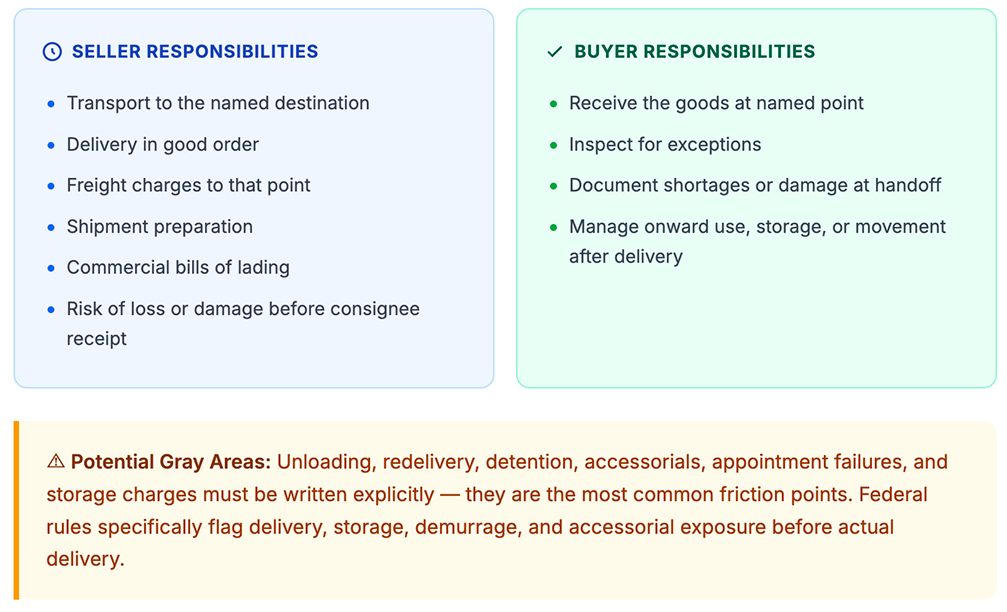
Under the U.S. Uniform Commercial Code, when the term is FOB — the place of destination, the seller must transport the goods to that place at the seller’s own expense and risk, and tender delivery there. Federal acquisition rules describe the same logic in practical terms, the contractor pays and bears charges to the specified delivery point and stays responsible for loss or damage before the consignee receives the shipment.

Here is the important distinction. FOB destination is not the same thing as FOB under ICC Incoterms. ICC states that Incoterms are a set of 11 trade rules used in sales contracts, and its FOB rule is maritime only, with risk passing when the goods are on board the vessel at the named port of shipment. ICC guidance also notes that for containerized cargo, FCA (Free Carrier) is often a better fit than FOB because container risk can become blurred long before vessel loading.
So if a shipper says "FOB destination" in a domestic procurement or warehouse delivery setting, they usually mean seller bears transit risk to the buyer's receiving point. If they say "FOB Shanghai, Incoterms 2020," they mean a very different thing — delivery on board at origin port, not destination delivery. Mixing those two concepts is where a lot of disputes begin.
How FOB destination works in the real shipment flow
The easiest way to picture FOB destination is to follow the shipment from the seller’s floor to the buyer’s receiving dock. Until the handoff point named in the contract is reached, the seller is still carrying the core delivery burden. The buyer may track the shipment, but the risk logic has not switched yet.
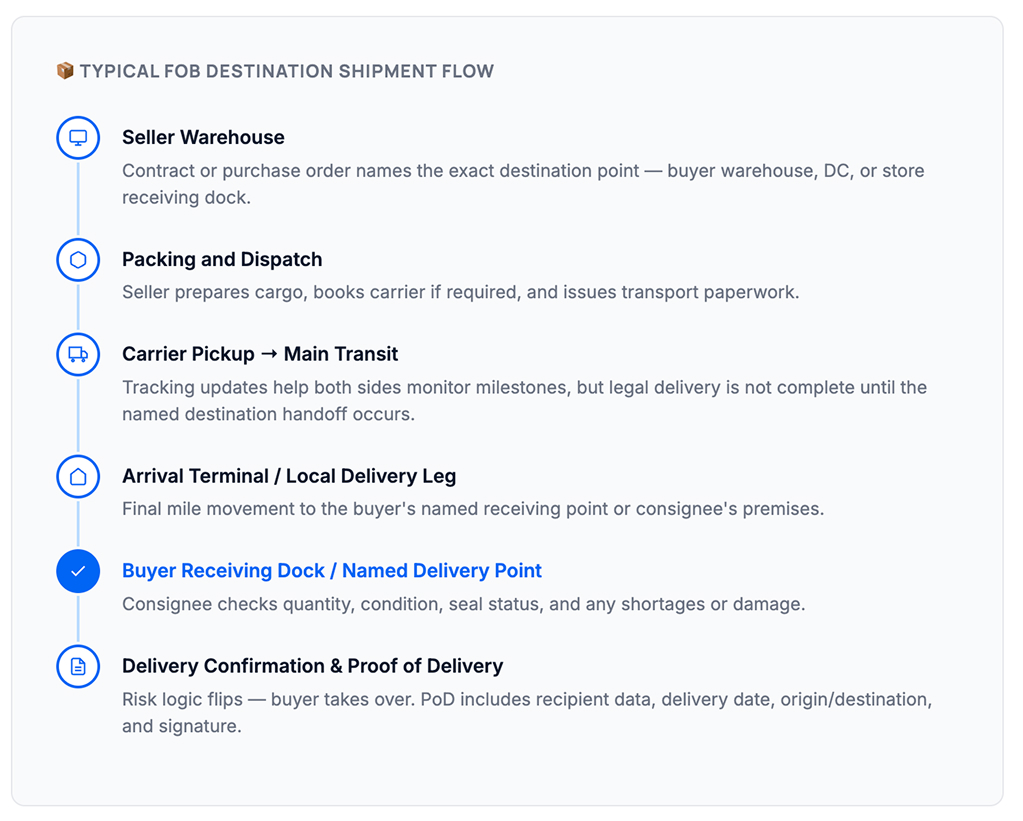
In practice, there are two useful “types” to keep in mind. First, there is standard FOB destination, where the seller gets the shipment to the buyer's delivery point. Second, there is FOB destination within consignee’s premises, a stricter version recognized in federal procurement that requires delivery inside the consignee’s premises, including specified rooms if stated. On top of that, commercial teams often layer freight charge modifiers such as freight prepaid or freight collect, which affect how freight invoices are paid, but do not automatically erase the seller’s transit risk under an FOB destination structure.
Risks, costs, and documents that actually matter
FOB destination looks simple on paper, but the real work sits inside the cost and risk split. If the contract is sloppy, small misunderstandings quickly turn into claims, delays, and margin leakage. Trade.gov also reminds exporters that documentation requirements vary by product and destination country, which means the sales term alone never tells the whole story.
The core documentation stack usually includes:
Commercial invoice, used by customs to assess duties and taxes in the buyer’s country.
Packing list, which itemizes package contents, dimensions, and weights, and is often used by freight forwarders to calculate freight and verify cargo.
Bill of lading, which CBP describes as a legally binding document that serves as a receipt for goods, a contract of carriage, and a document of title.
Proof of delivery, which closes the loop at handoff and becomes critical if there is a claim, billing dispute, or insurance question.
If the goal is to measure FOB destination efficiency, focus on metrics that expose friction at the handoff point, not just linehaul speed. The most useful KPIs are on time delivery to the named point, transit variance, documentation accuracy, claims rate, exception resolution time, proof of delivery cycle time, and total landed freight cost per shipment. Those metrics tell you whether the contract works in real operations, not just in legal theory.
Common problems show up fast:
- unclear destination wording,
- inconsistent invoice, packing list, and bill of lading data,
- poor visibility during transit,
- late proof of delivery,
- disputed accessorial charges,
- and weak exception handling when cargo arrives damaged or short.
FOB destination versus DAP, DDP, and CFR, and how clause switching works
If teams pick the wrong trade term, they usually do not notice until a delay, customs issue, or damage claim appears. That is why ICC and Trade.gov both emphasize choosing the term that matches who will manage shipment, documentation, and customs obligations.
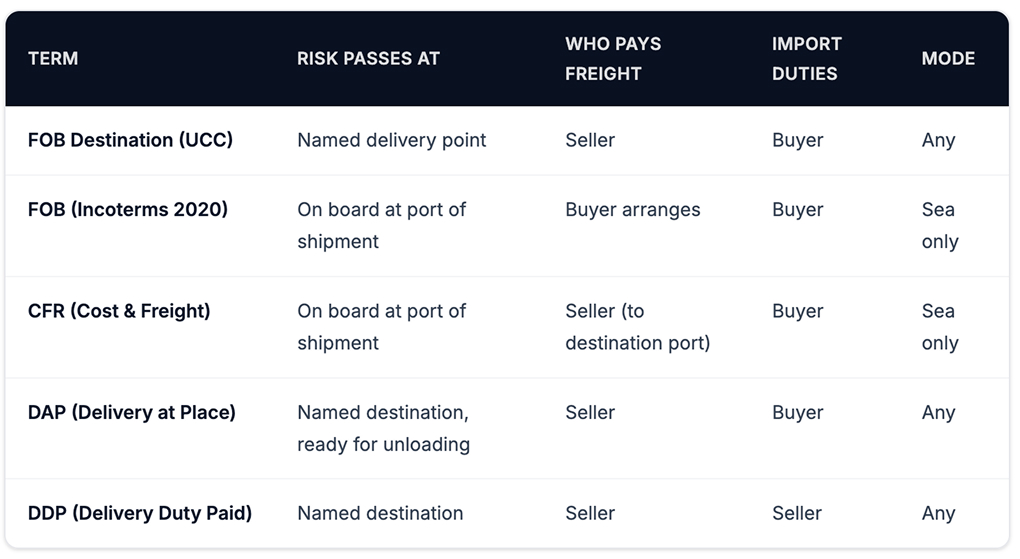
If you are “switching” from CFR to FOB, the cleanest view is this: you are not flipping a minor label, you are changing who arranges main carriage and where cost and risk separate. Under CFR, the seller arranges and pays ocean freight to destination port, but risk passes at origin loading. Under FOB, the buyer typically arranges the main carriage and risk also passes at origin loading once cargo is on board. That means booking control, documents, and freight payment logic all change, so the sales contract, booking instructions, and sometimes letter of credit language must all be updated together.
The best practice when setting or revising clauses is simple:
- name the rule clearly,
- name the exact place or point,
- state the version if using Incoterms 2020,
- define who handles insurance,
- define who handles accessorials and customs,
- and define what document proves delivery or completion.
How automation improves FOB workflows
FOB destination work is heavy on repetitive coordination, document matching, milestone tracking, and exception handling. AI helps most when it removes manual admin without removing human judgment. Recent research on freight logistics use cases highlights AI’s value in better decision support, forecasting, and workflow efficiency, and BCG reports that logistics players have already made meaningful progress in implementation even if large gaps still remain.
The bigger industry trend also supports this direction. DCSA says the bill of lading remains the most important trade document in container shipping, and that standards based eBL adoption can eliminate paper and manual intervention. UNCITRAL’s electronic commerce framework explicitly recognizes legal support for electronic transferable records such as bills of lading, and in 2024 it adopted a model law on automated contracting that also addresses automated systems and AI in electronic contracting.
That is the real proof point for automation’s role. The market is moving from paper chasing to structured, legally recognized digital workflows. Platforms like Wend AI position as an overlay on top of existing ERP, CRM, and TMS systems, with AI agents that read, update, and reconcile records through APIs and events rather than forcing a rip and replace system change. Wend AI also process documents such as bills of lading, airway bills, packing lists, delivery orders, and email threads, while keeping audit trails and role based controls in place.
In an FOB destination workflow, that can create high value gains in five places:
Document intake: extract data from invoices, bills of lading, packing lists, and email threads before the job even reaches the ops desk.
Cross document validation: catch mismatches between shipper, consignee, quantities, weights, terms, and references before cargo moves.
Milestone visibility: keep tracking events, delivery updates, and proof of delivery signals connected to the right shipment record.
Exception routing: highlight missing data, changed ETAs, or risky jobs so humans can intervene earlier.
Auditability and compliance: maintain logs, approvals, and system sync across ERP, TMS, and internal workflow layers.