
AI Agents in Warehouse Management: Solving WMS Pain Points for Better Efficiency
Modern warehouses run on complex inventory and order flows. Legacy Warehouse Management Systems (WMS) often struggle with the day-to-day headaches raised by operations managers: suboptimal slotting, inefficient pick paths, clunky replenishment rules, and manual back-office tasks.
These inefficiencies have real costs. For example, mis-picked orders can cost a distribution center $390,000 per year, while poor processes can waste 3,000 labor hours annually. Although over 90% of warehouses now use a WMS, many still rely on rigid rules and manual workarounds. Fortunately, artificial intelligence (AI) – specifically AI agents and analytics – can tackle these challenges by processing data in real time and automating decision-making. Used wisely, AI augments existing WMS capabilities, enabling continuous optimization of layout, picking, and staffing. In turn, this drives dramatic gains in productivity and cost savings – studies show smart automation can boost warehouse productivity by up to 50% and cut operational costs by around 30%.
In the following sections, we explore key pain points in today’s warehouse operations and explain how AI-driven solutions can address them. We’ll focus on practical improvements and highlight where an AI-powered platform like WendAI can help integrate these capabilities end-to-end.
Optimizing Inventory Placement and Slotting
One of the biggest pains is inefficient inventory placement. Instead of strategically slotting fast-moving SKUs for quick access, many warehouses simply stow incoming goods “wherever there’s space.” This random placement drives up picker travel time and slows throughput. Traditional WMS often lack dynamic slotting intelligence – they rely on periodic manual slotting projects or static location assignments, which quickly become outdated as order patterns change.
AI agents can continuously optimize slotting. By analyzing real-time order velocity and SKU movement, AI can predict which items should sit in “golden” zones near the dock and which can be stored further away. For example, AI-powered slotting systems learn SKU behavior over time, reshuffling inventory to reduce picker travel by 20–40%. Research shows up to half of pick time is spent walking between storage locations, so cutting travel has an immediate impact on lines per hour. An AI agent can run a perpetual “what-if” loop: it re-evaluates slotting rules, determines ideal placements, and even automates put-away moves. The result is a self-optimizing warehouse where high-demand items migrate automatically to the fastest zones and space utilization is maximized.
By eliminating one-off slotting projects, AI keeps the layout aligned with demand patterns. Instead of “tribal knowledge” or quarterly reviews, machine learning handles complexity (seasonality, promotions, new SKUs, etc.) on the fly.
Smarter Order Picking and Path Optimization
Inefficient picking routes are another major drag on efficiency. Classic WMS will often generate pick lists based purely on minimizing distance per order, but this can still send workers crisscrossing the building. Orders are rarely grouped by zone or urgency, so urgent picks might be buried at the end of a standard wave. The result is a lot of back-and-forth walking and wasted time.
AI-driven pick optimization changes the game. By analyzing all open orders, an AI agent can batch and sequence picks dynamically, grouping orders that have items in the same aisle or that share similar locations. It can also re-route in real time: for example, if a high-priority rush order comes in, the system can adjust the picker’s route on the fly. Smarter batching algorithms can also adopt multi-order picking techniques. Research shows that optimized multi-order pick paths can cut travel distance by up to 45% compared to naive routing. In practice, AI agents calculate the shortest, congestion-aware routes, so fewer footsteps translate directly into more orders per labor hour.
The contrast with legacy WMS is striking. Traditional systems may let pickers roam according to fixed “snake” routes or simple logic, but AI makes the plan data-driven and flexible. For example:
One AI agent might analyze historical pick data and discover that combining certain orders reduces overlap.
Another might factor in aisle congestion (busy areas) and send pickers on alternative paths.
The net effect is smoother flow: fewer cross-warehouse trips, balanced workloads, and faster fulfillment.
Warehouse experts note that even small reductions in travel multiply into big productivity gains. AI agents can also guide pickers on mobile devices or wearables, giving turn-by-turn instructions like a navigation app.
Intelligent Replenishment and Restocking
Keeping pick faces full is critical, yet many warehouses lack intelligent triggers for replenishment. In a typical WMS, replenishment is driven by fixed min/max levels or periodic scanning. This often leads to either too-frequent moves (wasting labor) or stockouts (interrupting picking). Managers lament that they have no “smart” assistant to answer questions like
- Do we have orders coming in for this SKU?
- Are we below minimum?
- Should we top it up now or later?
AI can automate replenishment decisions by looking beyond static thresholds.
For example, predictive analytics can watch real-time order streams and trigger restocking just before the picker empties a location, rather than waiting until after it’s empty. Industry stats show that predictive models enable “early restocking” and much better inventory flow. In practice, an AI agent might forecast next-day demand for each SKU, then schedule replenishment tasks during downtime to avoid disruptions. Or it can dynamically adjust min/max levels: rather than a one-size-fits-all rule, the agent learns the optimal buffer based on seasonality and lead times.
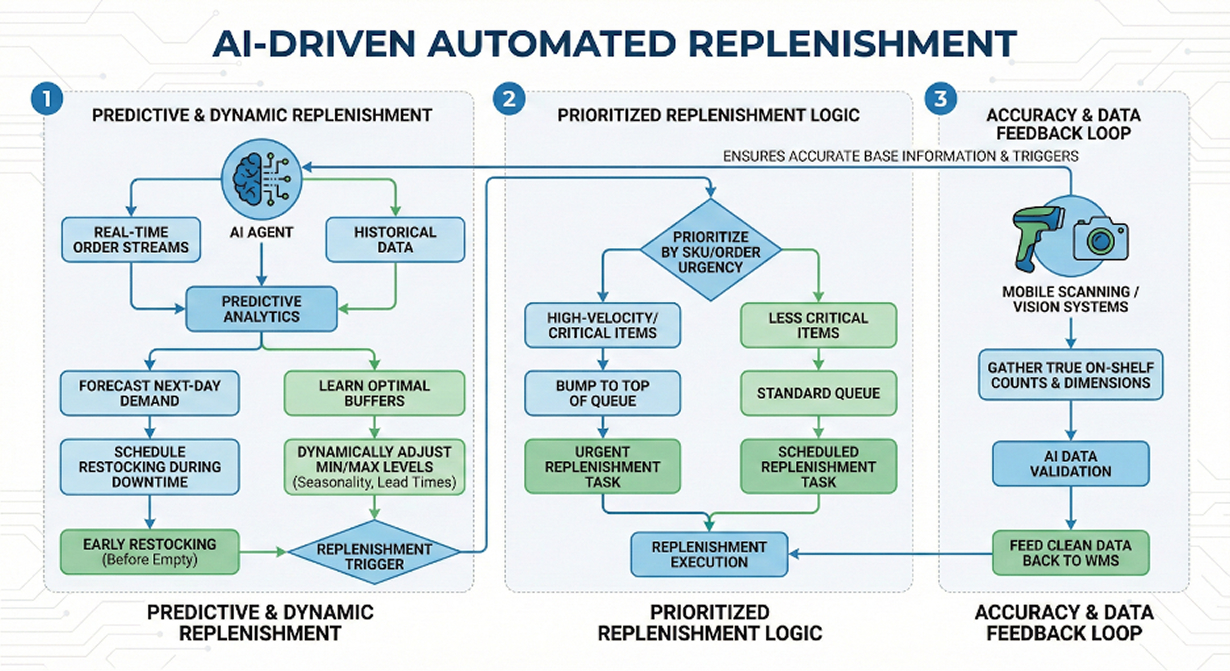
Additionally, AI can prioritize replenishment by SKU priority or order urgency. If a high-velocity product is running low, the system can bump its replenishment ahead of less critical items. This level of automation was illustrated by the manager’s ideal hierarchy: always check if there are orders now or soon, then compare against min/max, and replenish in that order. An AI agent can effectively enforce this logic 24/7, ensuring pick zones never dry up unexpectedly.
Finally, smarter replenishment ties back to accuracy. If item unit quantities or pack sizes are wrong in the system, any replenishment trigger fails. Here, AI combined with mobile scanning tools (or even vision systems) can help gather true on-shelf counts and dimensions, feeding clean data back to the WMS.
Automated ASN and Document Reconciliation
Reconciling inbound shipments is notoriously tedious in many warehouses. Operations managers report spending hours manually matching goods receipt data to Advance Shipping Notices (ASNs), packing lists, and invoices – often wrestling with errors like wrong quantities or missing references. This manual reconciliation is error-prone and costly.
AI solves this by automating document processing. Natural language processing (NLP) and OCR technologies can extract relevant data from emails, PDFs, or scanned documents. For instance, Wend AI’s platform automatically captures logistics data from any document or email and feeds it into downstream systems. In practice, an ASN email from a supplier is read by AI, and the contents (SKU, qty, shipment ID) are parsed into structured fields. The system can then auto-generate a receipt in the WMS or flag any discrepancies for review – eliminating 90% of manual entry.
This means receiving clerks no longer have to key in each line or hunt for errors; the AI agent does the legwork. It can even cross-check across multiple ASNs or invoice lines: if one SKU’s expected quantity is off, the agent highlights it immediately. By closing the loop between shipping docs and the WMS, AI significantly reduces the workload and improves accuracy.
Enhanced Forecasting and Labor Planning
Poor demand forecasts cripple staffing and inventory. Warehouse leaders often quote “we see forecast ranges of 80–120%” and find themselves scrambling when unexpected order spikes hit (e.g., unannounced promotions). Without visibility, managers end up over-hiring or burning out staff during peaks.
AI-driven forecasting and planning can dramatically improve this. Modern systems continuously analyze historical orders, market trends, promotions, and even external factors (like weather or ad campaigns) to produce more accurate demand forecasts. McKinsey estimates that AI in supply chain can reduce forecasting errors by 20–50% and cut lost sales by up to 65%.
How AI Supports Labor Planning
AI can do the heavy lifting of scheduling. Given a forecasted order profile and historical task times, an AI agent can assign tasks to workers and build shifts that match expected volume. For example:
If a picking wave usually takes 100 man-hours and orders rise 20%, the AI can recommend adding one extra shift.
Some advanced tools even consider individual performance data or seasonal patterns.
The AI continuously learns how long tasks actually take and adjusts future forecasts and headcount models.
By feeding accurate forecasts into the WMS, AI also improves work distribution. Pickers get smoother workloads (fewer last-minute shifts), and managers receive proactive alerts when labor requirements change. The human link stays intact— managers still make final calls, but AI makes those calls informed and timely.
Master Data Quality and Anomaly Detection
All advanced optimization depends on clean data. If the WMS has the wrong SKU weight or dimension, even the smartest AI suggestions will backfire. For example, incorrect case counts will break automated replenishment triggers, and wrong weight data invalidates shipping cost calculations or pick priorities.
AI can help with data validation and enrichment. For instance, computer vision or mobile scanners can quickly capture exact dimensions and packaging details of products, updating the system with a tap rather than manual tape measures. Some companies now use smartphone apps that perform on-the-spot dimensioning and data entry for each new SKU.
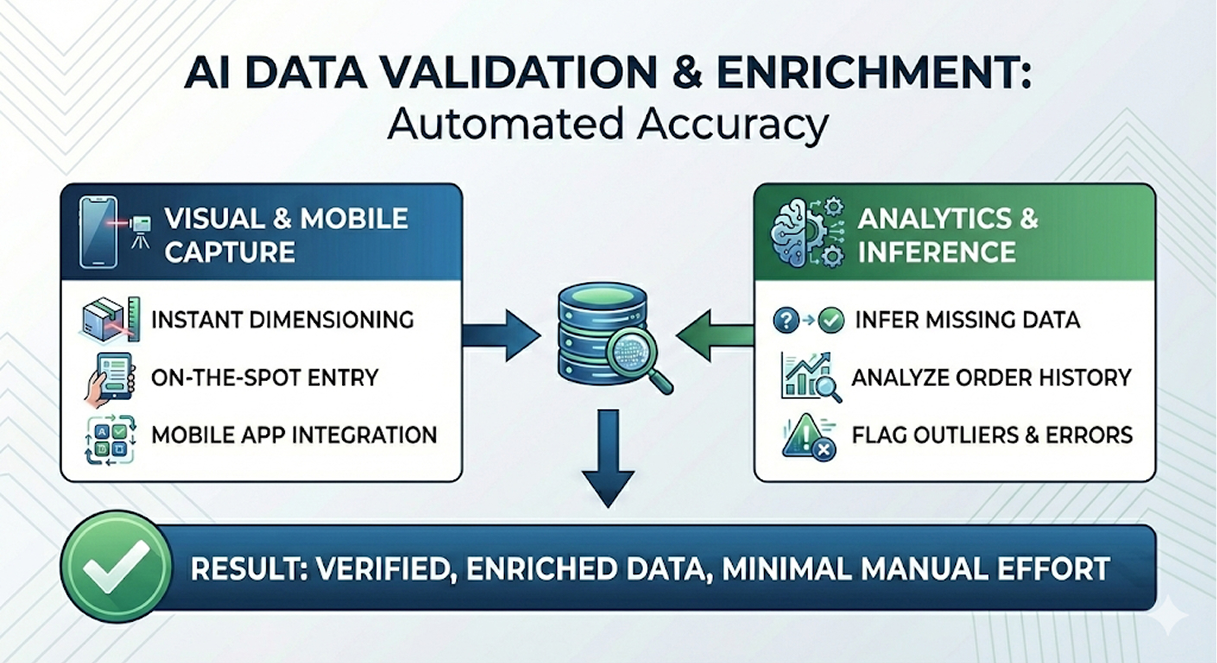
On the analytics side, machine learning can infer missing data: for example, by analyzing past order weights and quantities, an AI model might reverse-engineer the true unit weight of a product, spotting discrepancies without manual weighing. It can also flag unusual outliers, like a suddenly heavier-than-normal pack that might indicate a data entry error.
Addressing data quality is essential. Many WMS features (slotting, replenishment, even safety rules for hazardous items) rely on up-to-date master data. AI-driven checks ensure allergens or safety flags are correctly entered, and that pack factors align with how items actually stack on pallets. In short, intelligent data verification underpins all the gains – first clean the data, then let AI shine.
Network-Wide Visibility and Coordination
In multi-site operations, another pain point emerges: network coordination. Warehouse managers often juggle phone calls or Slack messages to rebalance inventory, avoid local capacity limits, or swap labor between sites. No system offers a real-time “big picture” view of capacity across all locations.
AI agents can provide that visibility. By aggregating data from each warehouse’s WMS and ERP, an AI agent can identify when one site is approaching full capacity and recommend actions such as:
- Diverting inbound trucks to nearby facilities
- Expanding temporary storage to prevent overflow
- Shifting stock from a low-volume site to a high-volume one
Similarly, an AI-driven dashboard could forecast network-wide throughput and suggest:
- Cross-docking transfers to smooth peaks
- Load-balancing moves before congestion hits
- Proactive scheduling for inbound and outbound flows
Although this capability is still emerging, the potential is clear: a smart “warehouse network manager” that balances load automatically.
WendAI: AI-Powered Warehouse Automation
While no AI platform can fix broken processes or poor data on its own, agent-driven systems like WendAI can shoulder a lot of the manual, repetitive, and error-prone work that slows warehouse teams down.
WendAI acts as a lightweight intelligence layer on top of your existing WMS. Instead of replacing systems, its agents support the day-to-day grind: cleaning up messy SKU master data, interpreting inbound documents, assisting with slotting insights, and flagging replenishment needs before they become fire drills.
For teams struggling with ASNs, emails, orders, label generation, and endless reconciliation, WendAI simply absorbs the administrative load. It automates the tasks that steal hours, and highlights the decisions that actually deserve human judgment. The result is faster turnarounds, fewer surprises, and more headspace for planning instead of patching.