

Automating Logistics Communication with Unified Platforms and AI Agents
In global logistics, communication is often a labyrinth of email chains and WhatsApp messages connecting forwarders, shippers, carriers, and vendors. These stakeholders exchange a torrent of information, like shipment schedules, rate negotiations, exception alerts, across disparate channels. Internal operations teams struggle to keep up: important details hide in lengthy threads, and juggling multiple conversations leads to missed information, delays, or costly errors.
In fact, one analysis estimates that inefficient email handling costs U.S. logistics operations $2.8 billion annually, with teams often processing over 500 emails per day. Faced with this volume, manual methods are unsustainable. The solution lies in unifying communication channels and leveraging AI agents to automate the flow of information, extract actionable data, and ensure complete coverage and follow-through.
Challenges of Email and WhatsApp Overload in Logistics
Logistics teams today face several pain points due to fragmented communication channels:
Multiple Disjointed Threads: Conversations splinter across email chains and messaging apps, leading to confusion, delays, and errors. Important context can be lost when information is scattered.
Manual Tracking and Skimming: Operations staff spend hours skimming through email threads to find updates or commitments. It’s easy to lose sight of a critical email or request amid the clutter, sometimes resulting in costly issues like missed pickups or demurrage fees.
No Single Source of Truth: Without a unified system, it’s difficult to track which messages pertain to which shipment or order. Teams may inadvertently work on outdated information or duplicate efforts due to lack of visibility.
Slow Response Times: During peak periods, response times can stretch to hours as staff triage an overwhelming inbox. Delayed replies or missed updates erode customer satisfaction and can trigger downstream delays in the supply chain.
These challenges not only drain productivity but also pose real business risks. Clearly, a better approach to managing these communications is needed.
Unifying Communication Channels for Clarity and Speed
The first step is to create a unified communication platform that brings together email and messaging into one hub. Instead of hopping between an inbox and a chat app, logistics teams get a single dashboard where all conversations are organized by context (such as by shipment, customer, or order). This consolidation has several benefits:
Centralized Visibility: All interactions are in one place, providing a complete view of the conversation history with each partner. Nothing stays hidden in personal inboxes or phone apps. Teams can quickly search and retrieve information without digging through multiple sources.
Streamlined Response Workflow: A unified channel ensures that inquiries from any source receive timely replies. For instance, integrating an email inbox with WhatsApp allows a message on one channel to be seen and addressed through the unified interface. This reduces the chances of oversight and cuts response times since staff don’t have to monitor numerous platforms.
Reduced Miscommunication: When everyone is effectively communicating through one platform, there’s less risk of parallel email threads creating confusion. A unified communication approach consolidates all customer interactions so teams can respond quickly and consistently. It also provides an audit trail of who said what, which is crucial for compliance and for resolving disputes later.
Industry solutions are already moving in this direction. For example, Bow Chat demonstrated that by connecting an email inbox with WhatsApp, businesses can manage all customer communications in a single view—simplifying management and improving operational efficiency. Similarly, platforms like Sedna embed email directly into logistics workflows: a smart email platform can automate tasks, integrate with Transportation Management Systems (TMS), and centralize conversations for full visibility. In practice, this means when a forwarder receives an update or quote request, the unified system immediately links it with the related shipment in the TMS, providing context at a glance and logging the exchange for future reference.
By unifying channels and tying them into logistics systems, companies lay the groundwork for automation. All communication flows through one funnel, where AI can then analyze and act on it effectively.
Automating Conversations with AI Agents
A unified platform is powerful on its own, but the real game-changer is layering AI agents on top to handle the heavy lifting of communication management. AI-powered assistants can monitor the unified inbox 24/7, understand what each message means, and trigger the appropriate responses or actions. Here are key capabilities that AI agents bring to logistics communications:
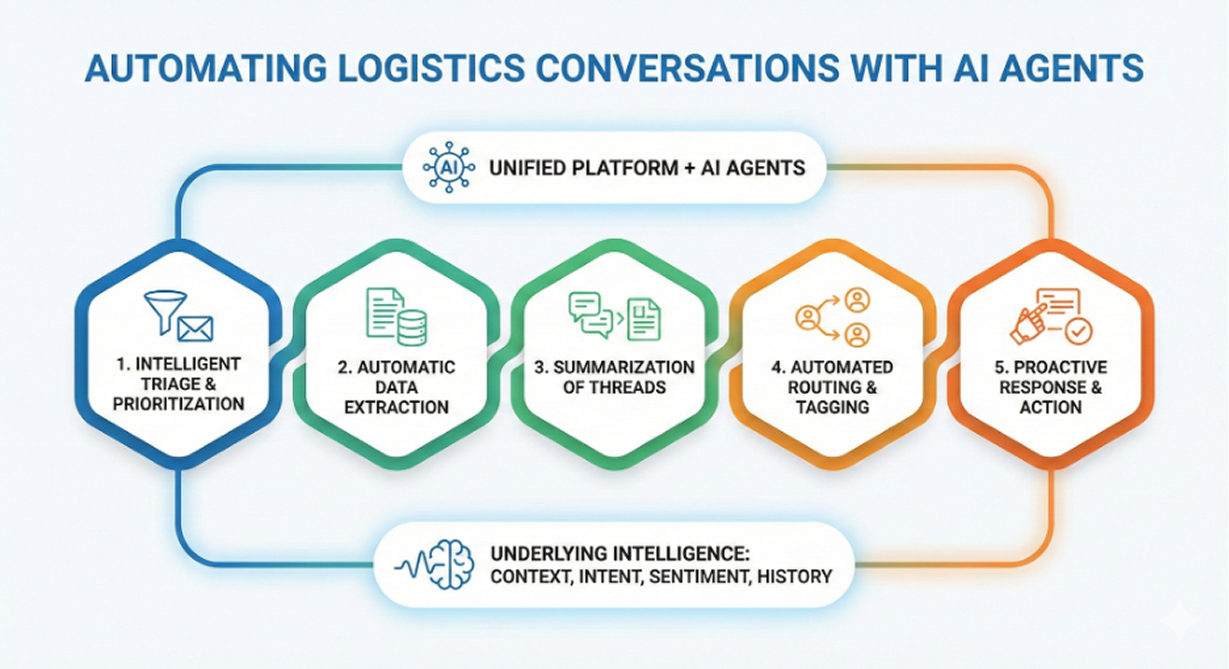
Intelligent Triage and Prioritization: AI agents can read incoming messages in real time and determine their urgency and topic. For example, if an email mentions a shipment delay, the AI recognizes it’s high-priority (especially for high-value or time-sensitive cargo) and can escalate it immediately. Routine messages like delivery confirmations, on the other hand, might be auto-archived or queued lower for later. By acting as an autonomous gatekeeper, the AI ensures critical issues are addressed within minutes, not lost in a crowded inbox.
Automatic Data Extraction: Natural Language Processing enables the AI to pull out key data points from unstructured messages. It can extract entities such as booking references, tracking numbers, ETAs, prices, locations, and PO numbers buried in an email thread. This “hidden” data is then made useful – for instance, the agent can update the corresponding fields in a database or TMS without any human retyping. Every email or chat becomes a source of structured data.
Summarization of Threads: AI summarization condenses long back-and-forth threads into concise insights. Logistics email chains often span dozens of replies. Instead of a human scrolling through all replies, an AI agent can generate a summary like: “Vendor A and Forwarder B negotiated rates – final agreed rate is $X for 10 containers, pending scheduling confirmation.” This synopsis highlights the decision, key figures, and any pending actions. In a logistics context, specialized AI agents are tuned to capture critical facts (dates, prices, approvals) so nothing important is missed in the summary.
Automated Routing and Tagging: Instead of team members manually forwarding emails or tagging colleagues, the AI can route messages to the right person or system. For instance, if a customer emails a quote request, the AI can detect this intent and instantly forward it to the sales queue or even create a new quote entry in the TMS. If a carrier update comes in about “vessel delay,” the AI could tag it as URGENT: Delay and notify the operations manager. Agentic AI can apply multi-factor rules – considering sender identity, message content, historical patterns – to decide where each message should go. In technical terms, these agents can push communications into other apps via APIs – for example, automatically sending a customs clearance email straight into the compliance system and populating the relevant forms.
Proactive Response and Action: Advanced AI agents don’t just sort information – they take initiative when appropriate. They can draft replies and even execute certain tasks based on the conversation’s context. For example, if a forwarder asks a vendor via email, “Can you update us with the latest rate for route X?”, an AI agent can recognize this request and autonomously fetch the dynamic rate from the vendor’s portal or API. It might then draft a response email with the updated rate and terms, ready for a human to review or send. This is the kind of automated quoting that is now emerging. By understanding the semantics of the exchange, the agent knows what outcome is expected and can either complete it or present a suggestion to the user.
These AI capabilities are driven by a deep understanding of context and meaning, not simple keyword matching. The agent interprets intent—for example, recognizing that a vague note like “there’s a slight hiccup” likely signals a delay when considered alongside shipment timing or value, and flagging it accordingly. It can also detect sentiment, prioritizing messages that indicate customer frustration even when phrased politely. By retaining conversational history, the AI identifies unanswered questions and prompts timely follow-ups, enabling it to function like a skilled operations coordinator that anticipates needs and ensures continuity.
Ensuring Accuracy and Trust with Proper Guardrails
Given the critical nature of logistics communications, deploying AI agents requires strong guardrails and oversight to ensure accuracy and reliability. Key strategies include:
Human-in-the-Loop for Exceptions: In the early stages of deployment, it’s wise to have AI handle the bulk of routine cases while humans review exceptions or uncertain cases. Many successful implementations use a hybrid model – the AI autonomously manages about 80% of communications, and the remaining 20% that are ambiguous or high-stakes get routed for human confirmation. This way, nothing critical slips through, and the AI continuously learns from the human feedback on those edge cases.
Continuous Learning and Tuning: AI agents should be trained on historical communication data (emails, transcripts) specific to the company’s operations. Training on 3–6 months of real data can allow the model to achieve 95%+ accuracy in recognizing intents and extracting correct information. Moreover, setting up a feedback loop – where the system is retrained or fine-tuned weekly based on errors or new scenarios – helps the AI adapt to evolving communication patterns and maintain high accuracy over time.
Validation and Verification: To prevent AI mistakes, important actions can be double-checked by secondary mechanisms. For example, if an agent pulls a rate from a vendor API, another process can verify that the number isn’t wildly out of expected range before it gets sent out. Similarly, an AI-generated email draft can require one-click approval by a human if it involves financial commitments or unusual situations. Some AI systems even employ self-verification loops – the agent reflects on its output and corrects itself if something looks off. Such built-in audits dramatically increase the reliability of AI actions.
Policy and Compliance Guardrails: Enterprises should enforce guardrails so that AI communications adhere to company policies and industry regulations. This includes privacy filters, tone checks, and role-based access control. Guardrail frameworks can automatically review each AI-generated communication before it’s sent, catching any compliance issues or anomalies. By controlling what the AI can and cannot do or say, companies avoid costly mistakes while still reaping automation benefits.
With proper safeguards, AI agents can deliver highly accurate and trustworthy communication automation. Early adopters report over 95% accuracy in email handling, with minimal need for human escalation, while SLA compliance improves to above 98%. AI’s speed and consistency, combined with targeted human oversight, creates dependable automation at scale. When continuously tuned, these systems adapt to evolving communication patterns and prevent a return to manual work. As a result, previously chaotic email threads become a reliable, structured source of insight rather than risk.
Real-World Impact and Future Outlook
AI-augmented communication is already reshaping logistics operations. Forwarders and 3PLs using AI-powered, unified inboxes are cutting response times in half, automating hundreds of emails a day, and unlocking significant productivity gains—often translating into six-figure annual savings. Alert-driven workflows ensure delays and exceptions reach the right teams instantly, improving delivery accuracy and customer satisfaction.
As vendors introduce Agentic AI into logistics communications, Wend AI stands out for its ability to turn messy, unstructured inputs into reliable, enterprise-ready outputs. By bringing structure, context, and consistency to high-volume communications, Wend AI enables teams to trust automation while staying focused on exceptions and decision-making.
Looking ahead, AI-driven communication platforms will become the operational nerve center—connecting systems, channels, and teams, while humans supervise, refine, and handle nuance. Done right, this human-AI partnership transforms inbox overload into a strategic advantage, making logistics faster, clearer, and more resilient.