

How to Run a Useful Pilot for AI Freight Quoting
A practical guide for freight forwarders to choose a workflow, measure the work involved and decide whether to expand.
An AI tool can extract an enquiry correctly and still leave a pricing executive with most of the work. Someone has to confirm the shipment details, check that the rate applies, reconcile the charges and prepare a quote the team can approve.
A useful pilot for AI freight quoting should establish whether that work becomes easier to complete correctly. Faster extraction is useful, but the business needs to know what happens to the whole workflow, including review, corrections and exceptions.
Start with one operational question: can this team prepare complete, reviewed quotes with less total staff effort? Then define the scope, evidence and acceptance criteria needed to answer it.
Choose a workflow with a clear boundary
For an initial freight quoting automation pilot, choose a recognisable part of daily work: one pricing team, one transport mode and a set of lanes it handles regularly. The scope should be narrow enough to investigate problems and broad enough to include the variation users actually encounter.
A team handling standard FCL export enquiries might test the process from incoming customer email to an approved quotation draft. Another team might focus on collecting and comparing spot responses from overseas agents. Choose the boundary around a bottleneck your team can identify.
Document the start and finish. Does the clock stop when enquiry details are extracted, when buy rates are available, when the draft is approved or when the quote is sent? These are different outcomes. If the pilot covers only intake, report intake improvements rather than claiming an improvement in the entire quoting process.
Set out exclusions, such as dangerous goods or specialist equipment, and decide how they will reach the appropriate person. Include ordinary complications within the chosen scope: missing dates, amended enquiries, multiple attachments and inconsistent vendor replies.
Use recent enquiries and a separate set of fresh cases. Keep a record of what was selected and excluded. It is always recommended to define the operating conditions for validation and documenting the limits of results. For freight quoting, that means being explicit about the lanes, shipment types and input formats the pilot has tested.
Agree what a usable quote must contain
Before measuring speed, have the pricing lead define what makes an output acceptable. A populated quotation template is only useful if the shipment details and commercial terms support the price being offered.
For the chosen workflow, agree the required shipment information, applicable rate source and version, charge basis, surcharges, validity and inclusions or exclusions. Specify who checks the selling price and who approves the customer-facing quote. Your team should be able to trace the underlying rates and any unresolved questions.
Consider an FCL enquiry with no cargo-ready date. The available ocean rate has a limited validity period, and a destination charge in an attachment is quoted per bill of lading. A useful test asks whether the process flags the missing date, checks rate applicability and preserves the charge basis. A plausible total produced by assuming these details should fail the review.
For an incomplete enquiry, the right output may be a clarification draft or an exception routed to a person. Count that as correct handling when it follows the agreed process. Do not reward the system for producing a quote that should have waited for clarification.
Measure preparation and review together
Establish a manual baseline using comparable enquiries. Record the human time spent on preparation, checking, corrections and approval, as well as elapsed time from receipt to the agreed finish point. Capture training and setup effort separately so it remains visible in the eventual rollout decision.
Use a small measurement set that covers effort, quality and the work the system leaves behind.
| Measure | How to record it | What it tells you |
|---|---|---|
| Total staff effort | Minutes spent preparing, reviewing, correcting and approving each enquiry, including manual fallbacks. | Whether work has reduced or moved to another person. |
| Time to the agreed finish point | Elapsed time from receipt to a reviewed draft or sent quote. Record customer and vendor waiting separately. | Whether the team can respond sooner and where delays remain. |
| Quote quality | Compare outputs with the agreed requirements. Log errors by type and commercial severity. | Whether faster processing preserves the required standard. |
| Exception handling | Track expected flags, missed issues, unnecessary flags and the action taken. | Whether incomplete or unsuitable cases reach the right person. |
| Coverage | Count all eligible enquiries, attempts, completed outputs and cases handled manually. | How much of the chosen workload the result actually represents. |
Count enquiries consistently. Several revisions of one enquiry should not become several completed jobs. Report manual cases alongside automated ones, and compare results within similar shipment types and complexity levels. A favourable average from simpler enquiries can obscure poor results on the work that takes most effort.
Keep commercially significant errors visible. An incorrect currency, omitted charge or inapplicable rate should not disappear inside a field-accuracy percentage. Record whether the issue was caught before approval, how it was resolved and whether it recurred.
Conversion and margin may matter over time, but a short pilot rarely isolates their causes. Customer mix, market rates and service availability also affect the result. Use them as context while making the initial decision on observed workflow performance.
Test historical enquiries before live quoting
Begin by replaying historical enquiries. Confirm that test activity cannot trigger customer or vendor messages. Give the test process the information available at the relevant point in the original workflow. Supplying later clarifications at the outset would make the task artificially easy.
Ask a pricing reviewer to assess the outputs against the agreed requirements and supporting evidence. The original manual quote is a useful comparison, but it may contain an error too. Resolve disagreements by checking the source material and commercial requirements.
Keep cases used to configure or correct the system separate from fresh evaluation cases. After a change, check both the original failure and new examples. Fixing one troublesome attachment does not establish that the wider workflow now performs reliably.
Once the agreed quality and control criteria are met, move to supervised live enquiries. Users should review outputs, make commercial decisions and approve external communications according to the pilot's agreed policy.
Agree when to pause a step and return to manual handling. Name the person authorised to make that decision and preserve the affected enquiry for investigation. A good practice is to assign responsibilities and defined mechanisms for bypassing or deactivating AI systems when their performance falls outside intended use.
Put ownership into the daily workflow
The pricing lead should own the acceptance criteria and resolve commercial disagreements. Pilot users should record corrections and explain where the process creates extra work. The implementation owner should coordinate fixes, while IT confirms permissions and the boundaries of any data exchange with existing systems.
Agree which rate sources will be available, who maintains them and how amendments are handled. Also establish where outputs are saved and which actions still take place in the existing system. A successful demonstration will tell you little about adoption if users must repeatedly copy the same information between tools.
Train people on actual enquiries, including how to correct an output, handle a missing detail and resume work manually. Include representative users as well as enthusiastic volunteers. During short reviews, ask which enquiries were completed, which needed intervention and why a user returned to the old process.
Keep an issue log linked to the source enquiry. Record the problem, commercial impact, temporary workaround, owner and retest result. Separate problems caused by source data, configuration, product behaviour and unclear internal rules. They require different fixes.
Use checkpoints to reach a decision
Agree a review date, but advance on evidence. A calendar duration alone does not establish that the workflow is ready for wider use. The following plan gives each stage an owner and a clear checkpoint:
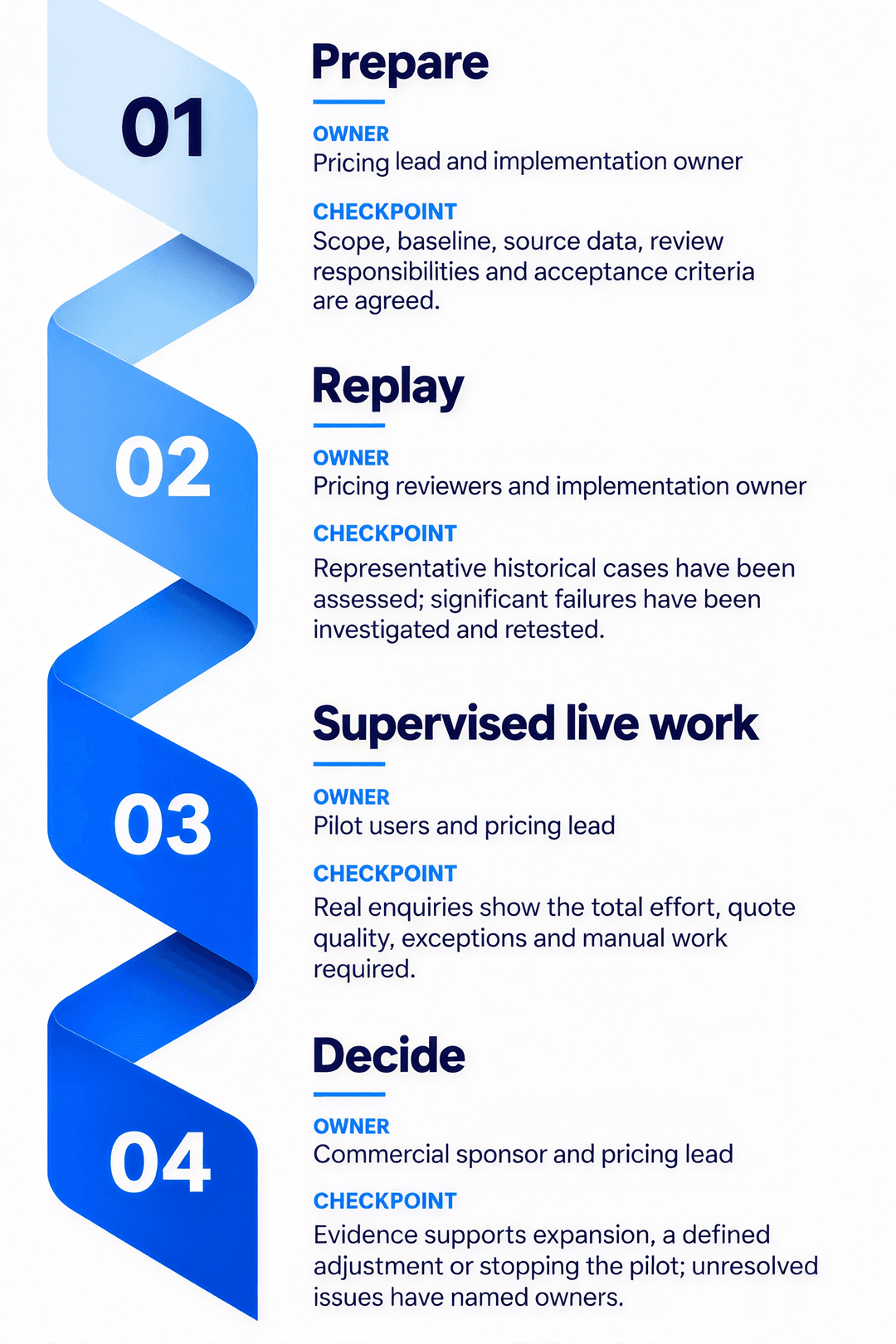
Set the expansion criteria before the first test. These should cover a worthwhile reduction in total effort, acceptable quote quality, reliable escalation and support the team can sustain. Treat an unresolved error that could materially change a customer quote as a blocker for the affected step, even when average processing time improves.
For the rollout decision, compare the observed effort reduction with licence costs, setup, training and ongoing support. Separate one-off implementation work from recurring effort. Do not turn time saved on a small sample into a staffing or revenue forecast without further evidence.
Expand when the evidence supports these conditions. Choose the next team, lane group or workflow deliberately and validate the differences. Results from standard FCL exports do not establish performance for airfreight or specialist cargo.
Adjust when a specific problem has a plausible fix and a clear retest. Extend only when additional cases will answer a named question. Stop when persistent review effort, unreliable outputs or impractical handoffs prevent the workflow from meeting its purpose.
Scope a Wend AI pilot around your quoting workflow
Wend AI supports enquiry capture, identification of missing information, rate sourcing, vendor response comparison and quotation preparation with review and approval. A pilot can focus on the part of that workflow where your team spends the most time checking, chasing or re-entering information.
Bring a representative set of enquiries, the rate sources your team uses and one measurable bottleneck. Agree the scope and review criteria with Wend AI before starting. Your pricing team retains responsibility for selling prices and commercial decisions.
At the end, you should be able to show which enquiries the workflow handles well, what still needs intervention and the effort required to keep it running. That evidence gives management a practical basis for deciding where to expand.
About the author