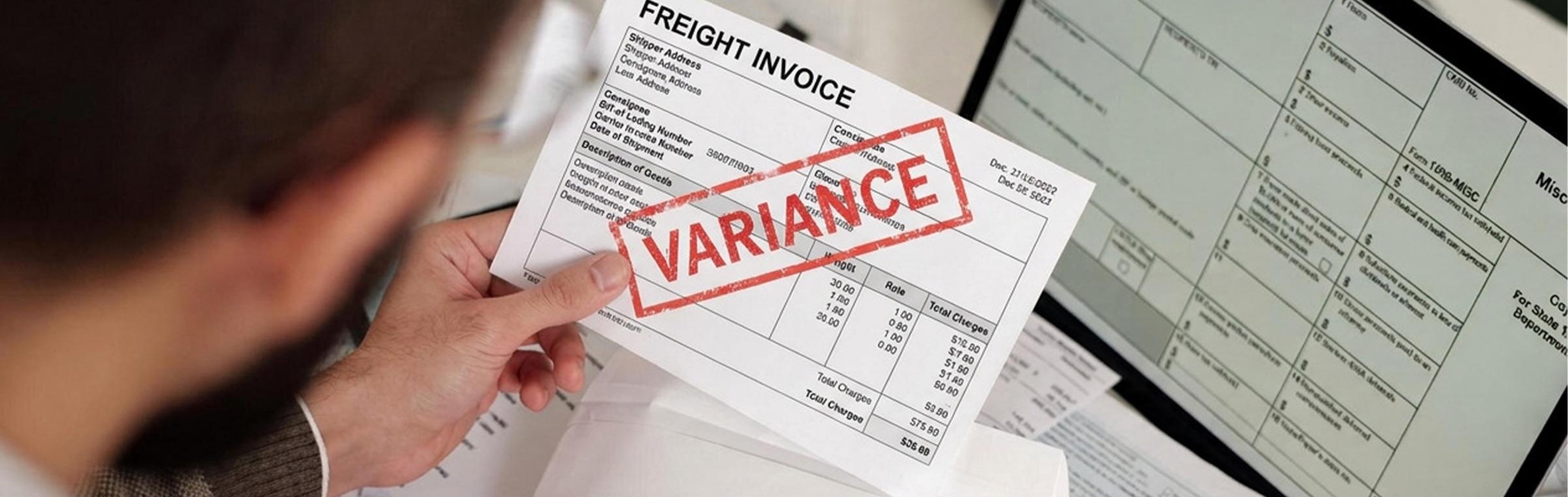

Freight Invoice Disputes: From Flagged Variance to Confirmed Credit
Finding an incorrect freight charge is only the beginning of recovering it. The team still needs to establish what should have been billed, submit the evidence, obtain a decision and reconcile the resulting adjustment.
A freight invoice dispute is a documented challenge to a specific billed amount, supported by the commercial terms or operational facts that justify a correction.
The strongest dispute records connect four things: the charge challenged, the evidence, the supplier’s decision and the financial adjustment. Without that connection, an accepted claim can remain unresolved on the supplier statement while the internal tracker says “closed.”
Establish the amount you can support
An invoice variance identifies a difference. Before challenging the supplier, determine what caused it.
An outdated expected cost, an approved service change or a different currency-conversion basis may explain the amount. A dispute needs a defensible position on what the supplier should have charged.
Record the billed amount, the amount supported by the applicable terms and the difference being challenged. Keep those values in the invoice currency, with tax shown separately where relevant.
Also distinguish between two different requests:
The charge conflicts with the agreement, calculation or service facts.
The charge may follow the agreed terms, but the customer is requesting relief because of exceptional circumstances.
Both can produce a credit. They rely on different arguments and may need different approvers. Presenting a goodwill request as a proven billing error makes the case harder to assess.
Build the evidence around the disputed charge
Sending the complete shipment folder gives the supplier documents to search. A stronger submission identifies the relevant evidence and explains what it establishes.
| Dispute reason | Evidence to assemble | What the submission should establish |
|---|---|---|
| Rate differs from the agreement | Accepted supplier quotation or contract, applicable version and booking details | Why that rate applies to this shipment |
| Incorrect quantity or equipment | Booking confirmation, equipment list, weight or measurement records | Which units or quantities should have been billed |
| Waiting-time charge | Arrival and departure records, agreed allowance and charging terms | The chargeable time after the applicable allowance |
| Demurrage or detention calculation | Free-time terms, availability and movement records, relevant terminal or return evidence | Which dates, rates or charging conditions are contested |
| Additional service charge | Service request, supporting event record and authorization where required | Whether the service occurred and was chargeable under the agreement |
Evidence should answer the disputed question precisely. A delivery receipt may confirm that delivery occurred without establishing three hours of waiting. An appointment screenshot may support a particular access problem without explaining the entire charging period.
For time-based charges, reconstruct the chronology. Identify the event that starts the clock, the free-time allowance, the chargeable period and the relevant rate tiers. Check calendar-day rules, time zones and whether event dates are included.
This makes the requested correction reproducible.
Make the submission understandable without another email
Include the invoice and shipment references, affected charge, disputed amount, reason, supporting calculation and requested outcome.
Be explicit about that outcome: a partial credit, cancellation and replacement, payer correction or explanation supported by missing documentation.
Keep the calculation at charge level even if the supplier’s dispute form operates at invoice level. One published portal guide, for example, requires detailed reasoning and supporting attachments while stating that individual invoice-position disputes are not supported. The internal record therefore needs more detail than the form alone may capture.
Save the submission acknowledgment and supplier case number. A draft email or internal approval does not establish that the supplier received the dispute.
Track dispute deadlines separately from payment terms
Every case needs two dates: the deadline for challenging the charge and the payment due date.
They can follow different rules. The dispute window may run from invoice issuance, receipt or another contractual event. An internal review queue should not obscure that starting point.
For covered U.S. demurrage and detention invoices, the applicable dispute-request rule requires the billing party to allow at least 30 calendar days from invoice issuance for mitigation, refund or waiver requests. It also requires an attempt to resolve a request within 30 calendar days of receipt, unless the parties agree to a later date. That is an obligation to attempt resolution, rather than a guarantee that a credit will be issued.
Other services and jurisdictions need their own applicable deadlines. Record the source of the deadline with the case.
Payment treatment also needs an explicit decision. For example, published carrier credit terms distinguish the disputed portion from the undisputed amount, require settlement of the undisputed portion and refer back to the original due date after resolution. Apply the terms governing the actual account and service.
Finance should document what is being held, what remains payable and who authorized that treatment. A dispute status in a portal should not silently become an instruction to hold the entire invoice.
Give each case an owner and a next action
A dispute can involve operations, pricing and finance without having three competing owners.
Assign one person to maintain the case and coordinate the next action. Other teams contribute the facts or decisions within their responsibility:
Any commercial settlement follows the relevant approval authority.
Track who currently needs to act, what they need to provide and when the next follow-up is due.
Supplier responses should produce a specific next step:
More evidence requested: Identify the missing fact, its owner and the response deadline.
Claim partly accepted: Separate the accepted amount from the amount still contested.
Claim rejected: Review the stated reason against the submitted evidence. An appeal should address that reason directly.
Credit approved: Obtain the adjustment document or confirmed account treatment and pass it to finance.
Repeatedly resending the original explanation adds little if the supplier has identified a different contractual basis. The next response needs to resolve that disagreement.
Where eligible U.S. ocean-shipping charges remain contested, current charge complaint procedures describe routes beyond the supplier’s internal process, including the interim procedure and traditional complaint processes. Choose an escalation route based on the charge, jurisdiction and alleged violation. An ordinary pricing disagreement does not automatically establish a regulatory breach.
Close the financial adjustment, not just the conversation
A supplier’s written acceptance establishes the decision. Finance still needs to verify its effect.
For a credit, check the supplier entity, account, currency, original invoice reference, amount and applicable tax adjustment. Then confirm that it has been recorded correctly and applied through the agreed settlement method.
Available credits can sometimes be applied against open invoices through a carrier portal, but availability and application depend on the account and supported process. Published payment guidance shows credit application as a distinct action during settlement.
A credit remaining on account should therefore stay visible until its treatment is confirmed.
Consider this illustrative outcome, excluding tax:
A forwarder disputes $180 of a $1,260 invoice. The supplier accepts $120 and provides evidence supporting the remaining $60. The forwarder accepts that evidence.
The final valid charge is $1,140.
If the original invoice remains unpaid, finance needs to reconcile the $120 adjustment against the amount due.
If it has already been paid, finance needs to track the agreed refund or credit application.
The disputed amount was $180. The accepted correction was $120. The financial benefit is confirmed only when that correction is reflected in the relevant records and settlement.
Where the invoice affects several shipments, allocate the adjustment to the jobs and charges it actually corrects. Posting the credit to a general account can leave shipment margins overstated.
Measure where disputes stop moving
A single “open” status hides very different problems.
Separate cases awaiting internal evidence, awaiting supplier review, awaiting an adjustment document and awaiting credit application or refund. Ageing each stage shows whether the delay sits inside the forwarder’s operation or with the supplier.
Track disputed value, accepted adjustments and reconciled adjustments separately. Measure outcomes for a consistent group of cases so that unresolved claims do not distort the result.
Reason codes also make disputes useful beyond recovery. Repeated rate-version errors may point to a supplier setup problem. Recurring quantity disputes may expose a handoff issue. Credits that remain unapplied suggest a reconciliation gap.

Wend AI supports the earlier work by connecting invoice validation, supporting documents, discrepancy notes and human approvals. That gives reviewers a clearer basis for deciding what needs investigation.
The dispute process should carry that evidence through to a verified outcome: the supplier decision recorded, the adjustment reconciled and any remaining amount assigned for action.
About the author