
LCL vs FCL Shipping: How Freight Forwarders Should Decide Beyond Cargo Volume
Freight forwarders should treat LCL vs FCL shipping as a landed-cost and control decision, not just a CBM decision. Cargo volume still matters, but handling exposure, local charges, cargo sensitivity, supplier count, and quote readiness usually decide whether LCL shipping or FCL shipping protects margin and customer experience.
This article assumes no specific trade lane, currency, or carrier contract. The thresholds below are practical ocean freight heuristics, not fixed buying rules; final mode choice should always be confirmed against current door-to-door pricing and local charges.
Volume Is the First Filter, Not the Decision
In standard container shipping, LCL shipping means multiple shippers share one container and pay for the space used, usually measured in CBM (Cubic Meter). FCL shipping means one shipper books exclusive use of the container, even if it is not physically full.
Operationally, that difference changes the flow: LCL usually adds consolidation and deconsolidation through a Container Freight Station, while FCL stays as a sealed unit with fewer touchpoints.
That is why the decision affects more than price. It also affects cargo handling, customs administration, release risk, and the predictability of cargo availability at destination.
LCL vs FCL at a Glance
The comparison below reflects the standard operating patterns used across ocean freight for shared-container and dedicated-container moves.
Factor | LCL shipping | FCL shipping |
|---|---|---|
Container use | Shared with other shippers | Exclusive to one shipper |
Base pricing | Usually by CBM and cargo profile | Fixed rate per container |
Terminal flow | CFS-based consolidation and deconsolidation | Typically sealed, fewer handoffs |
Transit profile | More variable because of shared handling | More predictable |
Handling exposure | Higher | Lower |
Best fit | Smaller or irregular volumes, market testing, flexible replenishment | Larger volumes, fragile cargo, high-value cargo, regulated cargo |
Common risk | Extra local/CFS charges erode savings | Unused capacity erodes unit economics |
LCL vs FCL Cost: The Real Break-Even Band
A lot of guides reduce LCL vs FCL cost to one line: LCL below 15 CBM, FCL above it. That is directionally useful, but it is too blunt for a quote desk. In practice, forwarders should think in bands. Below roughly 8 to 10 CBM, LCL is usually the default. From about 10 to 18 CBM, both modes should be compared. Beyond roughly 15 CBM, FCL often becomes commercially competitive or better, especially once local handling is included.
The break-even moves because ocean freight is not billed the same way in each mode. LCL is generally pay-for-what-you-use, but it can also attract weight-related charges and minimums. FCL spreads a fixed container rate across units, which improves unit economics quickly as volume rises. Dense cargo, fragile cargo, or freight that needs tighter handling control can tip the decision toward FCL earlier than the CBM headline suggests.
Forwarders should also remember that FCL can win before a container is "full." One dedicated container often means fewer handovers, lower damage exposure, and easier customs coordination than repeated CFS handling on LCL. That matters to margin control because the cheapest ocean line item is not always the cheapest delivered shipment.
Hidden Costs Forwarders Should Model Before Advising
A clean LCL vs FCL shipping comparison must be done door-to-door, not on base freight alone. The cost lines most often missed are these:
Origin and destination CFS handling, consolidation, and deconsolidation
Documentation, filing, customs-clearance, terminal, and local port charges
Weight-related pricing effects, minimum chargeable CBM, and cargo-density penalties
Accessorials such as liftgate, limited-access delivery, residential delivery, appointment delivery, or redelivery
Packing, crating, palletization, storage, detention, demurrage, and customs exam exposure
Leaving these items outside the quote is how an apparently cheap LCL rate turns into a weak landed-cost outcome. In real forwarding work, destination CFS charges and local delivery accessorials are often the difference between a good LCL recommendation and a preventable margin miss.
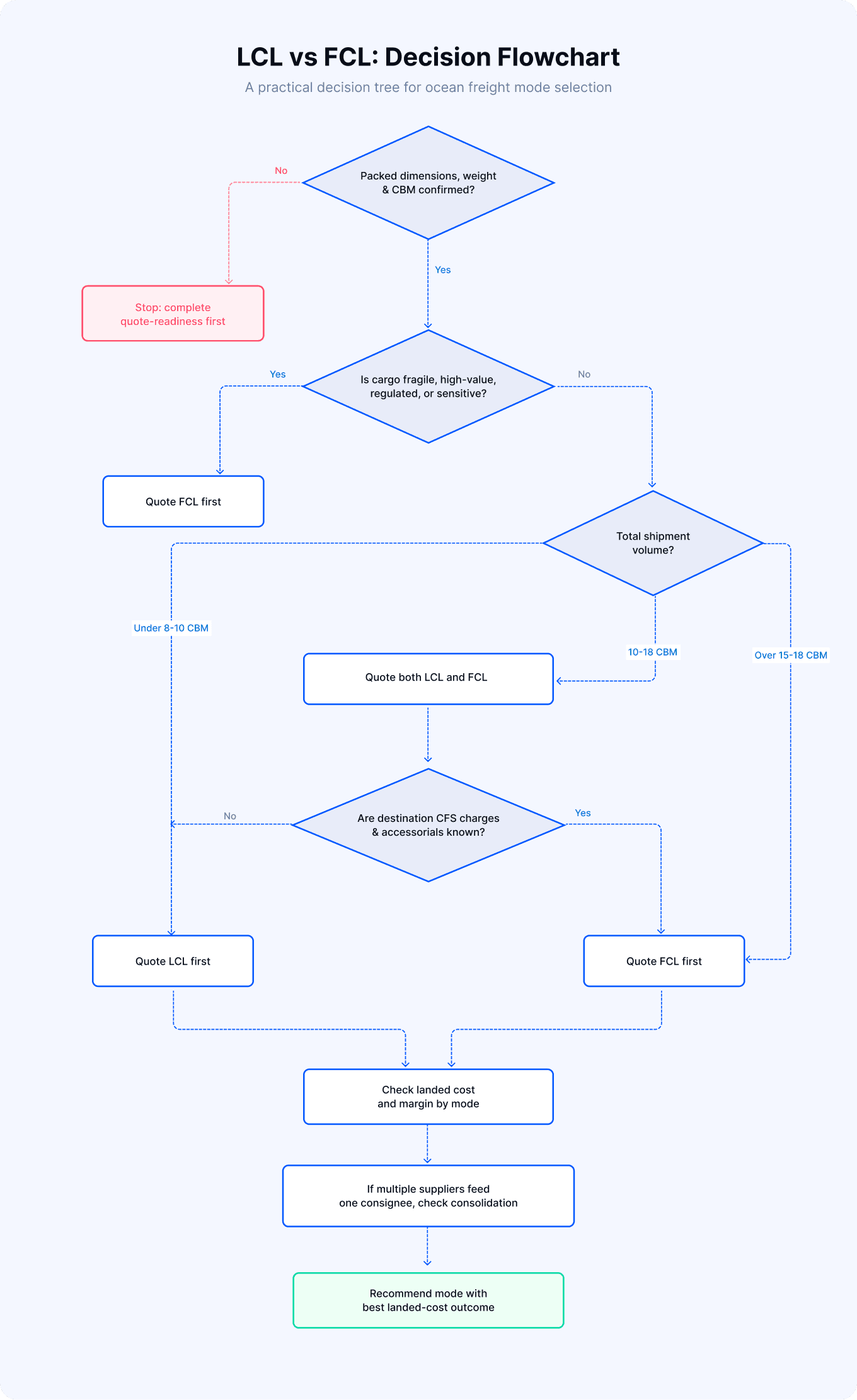
A Practical Decision Tree for Ocean Freight Quoting
Use this logic as a working SOP for pricing and operations teams. It is deliberately simple: validate the shipment first, then decide the mode.
Quote Readiness for LCL Shipping and FCL Shipping
Mode selection is only defensible when the quote is quote-ready. Before choosing LCL shipping or FCL shipping, the forwarder should have these fields confirmed:
Final packed dimensions, weight, stackability, and chargeable CBM
Cargo sensitivity: fragile, high-value, regulated, temperature-sensitive, odor-sensitive, or contamination-sensitive
Incoterm and who owns origin and destination local charges
Delivery profile: port, CFS, door, residential, appointment, liftgate, or limited-access site
Supplier count, cargo-ready dates, and whether origin consolidation can turn multiple LCL moves into one FCL
Rate validity, exclusions, and target margin by mode
This is where [freight pricing governance] and [quote readiness] matter upstream. If local charges, accessorial rules, and packed dimensions are not controlled before the quote desk works the shipment, the forwarder is not choosing a mode with confidence; it is guessing.
When Forwarders Should Quote Both Options
The smartest forwarders quote both modes in a defined threshold band instead of arguing from rules of thumb. That usually means shipments around 10 to 18 CBM, fragile or high-value cargo, uncertain destination delivery conditions, or any shipment where the customer asks for LCL by default without seeing the landed-cost math.
Practitioner patterns are consistent here. One recurring case is bulky or delicate cargo hovering around 13 to 15 CBM: the LCL ocean rate looks lower, but destination CFS charges, extra handling, and damage exposure pull the total above FCL. The opposite pattern is a 4 to 6 CBM replenishment or market-test shipment where LCL keeps inventory lean and avoids paying for empty container space.
Another missed lever is multi-supplier consolidation. If one consignee is receiving cargo from several suppliers in the same origin window, buyer’s consolidation deserves a formal check. That can convert fragmented LCL bookings into one dedicated FCL, improving utilization, reducing handling, and simplifying customs and destination handling.
Build a Lane Policy and Measure It
A practical forwarding policy is simple. Default to LCL below the low-volume band unless cargo sensitivity or destination complexity flags otherwise. Require dual LCL/FCL quotes in the threshold band. Default to FCL above that band unless the shipment needs multi-destination splitting or cargo readiness is staggered. For multi-supplier inbound moves to one consignee, require a consolidation check before sending separate LCL options.
Then measure it. The best KPIs are the dual-quote rate inside your threshold band, quoted-versus-invoiced variance, gross margin by lane and mode, damage or dispute incidence by mode, on-time cargo availability, and the share of multi-supplier shipments converted into one FCL. If your challenge starts earlier in the workflow, connect this policy to your [rate sheet processing] practices so the quote desk is comparing governed inputs rather than partial rates.
How Wend AI Helps
LCL vs FCL decisions are easier when pricing teams have complete, quote-ready context before they respond.
Wend AI helps freight forwarders structure shipment details, rate inputs, surcharges, local charges, validity dates, and approval checks in one workflow. That gives teams a clearer view of the full cost picture before recommending LCL, FCL, or both.
The goal is not to replace freight judgment but to help forwarders quote with fewer assumptions, better margin visibility, and more confidence in the recommendation they send to the customer.
See how Wend AI helps freight forwarders turn messy rate inputs into quote-ready decisions.
FAQs
There is no universal line, but a practical answer is this: LCL is usually the default below about 8 to 10 CBM, a dual quote is wise in the 10 to 18 CBM band, and FCL often becomes more competitive from around 15 CBM onward once local handling is added.
Usually on the base ocean rate, yes. Not always on landed cost. CFS handling, destination charges, documentation, and delivery accessorials can remove the apparent advantage quickly.
Avoid LCL when cargo is fragile, high-value, regulated, contamination-sensitive, or highly delivery-critical. Shared-container handling and dependency on other shippers’ clearance can increase both release risk and damage exposure.
Quote both when shipment volume sits near the break-even band, when multiple suppliers feed one consignee, when delivery conditions are uncertain, or when bulky cargo is close to filling a 20-foot container.
Require packed dimensions, Incoterm, destination delivery profile, and local-charge ownership before pricing. That one discipline improves quote readiness, sharpens margin control, and reduces avoidable LCL-vs-FCL misquotes.