

TEU vs FEU in Ocean Freight Quotes: How Unit Conversion Creates Margin Risk
TEU and FEU make ocean freight easier to compare, but they can make ocean freight quotes less accurate when they are treated as commercial pricing units instead of normalization units. In practice, a quote is sold by equipment type and charge basis: 20GP, 40GP, 40HQ, per container, per move, per document, or per TEU. Once a rate sheet mixes those bases, the risk of pricing error rises quickly.
That is why TEU vs FEU in ocean freight quotes is not a terminology issue. It is a control issue. A forwarder may understand that 1 FEU equals 2 TEU in physical capacity, but that does not mean a 40-foot quote should be priced as two 20-foot quotes. Carrier pricing, surcharge logic, equipment type, and local charges often break that assumption. The result is familiar: quotes that look right in the spreadsheet but miss the real cost basis, weaken margin, or create avoidable rework before booking.
What TEU, FEU, 20GP, 40GP, and 40HQ Actually Mean
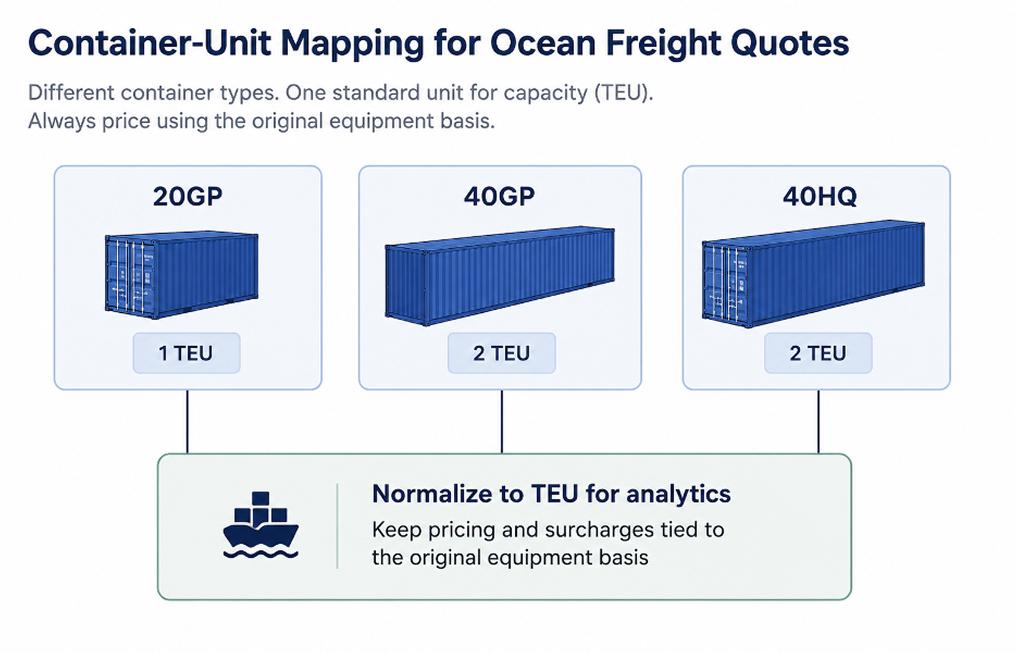
In container shipping, TEU is a standard planning unit based on a 20-foot container. FEU is the equivalent of a 40-foot container, or two TEU. Those units help with capacity reporting and lane analysis, but the actual box booked is usually quoted as 20GP, 40GP, or 40HQ.
That difference matters. A 40HQ and a 40GP are both 2 TEU on paper, but they do not always carry the same commercial rate. The quote desk must preserve the original equipment logic, not just the TEU math.
Shipping term or equipment | What it represents | TEU equivalent | Typical quote basis | Main quoting risk |
|---|---|---|---|---|
TEU | Twenty-foot equivalent unit used for benchmarking and capacity math | 1 | Per TEU in analytics or certain surcharges | Useful for normalization, but not always the right sell basis |
FEU | Forty-foot equivalent unit used as a shorthand for 40-foot space | 2 | Per FEU or per 40-foot container | Often used too broadly when 40GP and 40HQ should be separated |
20GP | 20-foot general purpose container | 1 | Per 20GP | Mistakenly doubled to price 40-foot equipment |
40GP | 40-foot general purpose container | 2 | Per 40GP or FEU | Confused with 40HQ or treated as exactly 2 x 20GP |
40HQ | 40-foot high cube container | 2 | Per 40HQ or HC | Same TEU as 40GP, but often a different rate and cargo cube |
Why 1 FEU Does Not Equal 2 TEU in Price
The most common mistake in TEU vs FEU in ocean freight quotes is assuming physical conversion and commercial pricing follow the same rule. They do not.
A 40-foot container does represent twice the TEU of a 20-foot unit, but the rate is shaped by commercial factors that sit outside pure capacity math. Carrier yield management may favor 40-foot boxes on one lane and 20-foot units on another. A terminal charge may be billed per container move rather than per TEU. Inland haulage is usually priced by box and route, not just by TEU count. Documentation, seal, and compliance charges are often flat per container. High cube equipment may attract a premium even though its TEU count is the same as a 40GP. That is why one FEU can price below, equal to, or above two TEU depending on the lane and charge type.
For quote accuracy, the practical rule is simple: use TEU for comparison and normalization, but use the original equipment and charge basis to build the quote.
Where Rate Sheets Create Unit Confusion
Mixed container-unit logic rarely appears as one obvious mistake. It usually shows up as small inconsistencies across tabs, notes, surcharge columns, and equipment labels.
The same sheet may show base ocean freight by 20GP / 40GP / 40HQ, but show bunker or security charges per TEU.
A rate file may use FEU as shorthand for 40-foot equipment without confirming whether that includes 40GP only or 40HQ as well.
Origin and destination charges may be billed per container, while local notes or add-ons are listed per shipment or per document.
In some sheets, 40HQ is missing from the base rate but appears later as an equipment-specific surcharge or note.
Tactical updates often change one basis and not another, leaving validity windows mismatched across units.
These issues are easy to miss because the numbers still look internally consistent. The error shows up only when the quote reaches a real shipment profile.
How Unit Confusion Turns Into Margin Leakage
Consider a simple base-ocean example. A rate sheet shows 20GP = 1,100 and 40GP = 1,850. If a pricing team receives a request for 1 × 40GP but converts it mechanically to 2 TEU, they may cost it at 2 × 1,100 = 2,200. The quote is now 350 above the actual 40GP base rate before any margin is added. That can kill competitiveness or distort win-loss analysis because the problem sits in the cost basis, not the sell strategy.
The opposite error is more dangerous because it hides inside margin. Imagine destination handling is listed as 180 per 20GP and 340 per 40HQ, while documentation is 75 per container. If the analyst prices a 40HQ by doubling the 20GP charge and misses the flat box-level doc fee, the quoted cost becomes 360. The real cost is 415. The quote is under by 55 before margin.
A third version occurs when FEU is treated as a universal 40-foot rate. If the sheet actually distinguishes 40GP = 1,850 and 40HQ = 1,930, but the team maps every FEU request to the lower 40GP rate, the missing 80 is not visible until booking or invoicing. That is how small unit errors turn into repeatable margin leakage.
Normalization Checklist for Container Rate Sheets
Before TEU vs FEU in ocean freight quotes can be controlled, the rate sheet has to be normalized into a single structure.
Separate equipment type from unit of measure. A row should never store “FEU” as a substitute for the actual booked equipment if the sheet also distinguishes 40GP and 40HQ.
Capture the original charge basis for every line: per container, per TEU, per shipment, per document, or per move.
Store both the original equipment label and the normalized TEU equivalent so analytics do not overwrite quoting logic.
Tag each charge by scope: base ocean freight, origin local, destination local, documentation, inland, or surcharge.
Keep currency, validity, and routing at line level. Do not inherit them from the tab name or a note field.
Preserve any equipment-specific notes such as HQ premium, free days, overweight terms, or excluded charges.
Validation Rules Before a Quote Goes Out
Once the sheet is normalized, the quote still needs controls. Every line should carry both the original basis and the transformed basis used for internal analysis. FEU should never auto-populate 40HQ unless the commercial rate explicitly covers high cube. Charges billed per container should stay per container and should not be divided into TEU-based averages for quoting. If the customer asks for 1 × 40HQ and only a generic FEU field is available, the rate should be flagged for review rather than assumed. Base freight, surcharges, and local charges should also be checked for aligned validity. These are not complex controls, but they remove most silent unit errors before they become customer-facing quote errors.
In ocean freight quotes, TEU is a normalization tool, not a cash tool. FEU is useful shorthand, but it still not precise enough to replace actual equipment logic. When a pricing team collapses TEU, FEU, 20GP, 40GP, and 40HQ into one interchangeable layer, the quote becomes easier to build but harder to trust.
Make Container Rate Data Quote-Ready
Wend AI helps freight forwarders extract TEU, FEU, 20GP, 40GP, and 40HQ data from carrier rate sheets and map each line into a quote-ready structure.
It preserves the original pricing basis, such as per container, per TEU, per shipment, or per document, so normalization does not distort the commercial charge. It also flags missing equipment mappings, mixed unit logic, and surcharge mismatches before the quote is issued.
The result is cleaner ocean freight quote readiness, better margin visibility, and fewer avoidable pricing exceptions.
See how Wend AI turns messy ocean freight inputs into quote-ready pricing decisions.
FAQs
TEU means twenty-foot equivalent unit — based on one 20-foot container. FEU means forty-foot equivalent unit and usually represents one 40-foot container, or 2 TEU. TEU and FEU are useful for capacity and comparison, but ocean freight quotes still need the actual equipment type: 20GP, 40GP, or 40HQ.
For capacity measurement, yes. For pricing, not always. A 40-foot container may equal 2 TEU, but the freight rate, local charges, surcharges, and equipment premiums may not follow a simple two-times calculation.
Ocean freight pricing depends on carrier rates, equipment availability, lane demand, surcharges, terminal charges, local fees, and container type. A 40GP or 40HQ rate may be lower or higher than twice the 20GP rate depending on the lane and charge basis.
Yes, both are generally treated as 2 TEU for capacity measurement. But they should not always be treated the same in pricing. A 40HQ may carry a different rate, surcharge, or equipment condition than a 40GP.
TEU vs FEU matters because rate sheets often mix container sizes, pricing units, surcharges, and charge bases. If those fields are not normalized correctly, the quote desk may overquote, underquote, miss charges, or apply the wrong margin.
Container rate normalization means converting mixed carrier rate sheet data into a consistent structure while preserving the original pricing basis. For example, a system may normalize 20GP, 40GP, and 40HQ into TEU equivalents for analytics, but still price each quote using the correct equipment-specific rate.
Forwarders should use TEU for comparison and analytics, but price using the actual container type and charge basis. The quote should reflect whether the customer requested 20GP, 40GP, 40HQ, or another equipment type.
Forwarders can reduce container unit errors by separating equipment type from unit of measure, preserving the original charge basis, validating surcharges by container type, checking validity dates, and flagging unclear FEU or 40HQ mappings before quoting.