

Incoterms for Freight Forwarders: A Practical Guide to Quote Logic, Cost Responsibility, and Risk Transfer
Incoterms are not freight rates. They are responsibility rules. They tell you who arranges carriage, who pays each cost block, and where risk transfers from seller to buyer. They do not set the freight price, the customs duty, the insurance premium, or the margin. For freight forwarders, that distinction is everything. The same shipment can price very differently under EXW, FOB, CIF, DAP, or DDP because the commercial scope changes, even when the cargo, route, and carriers do not.
A strong quote, then, starts with the rule and ends with the components. The rule tells you what belongs in scope. The quote engine then prices the actual components: origin pickup, origin handling, export clearance, origin THC, main freight, freight surcharges, insurance, transshipment handling, destination THC, destination handling, import clearance, duty and tax, final delivery, unloading, internal fees, and margin. The named place matters just as much as the three-letter term.
Why Incoterms Matter in Freight Forwarding Quotes
Freight forwarders run into two mistakes again and again. First, teams treat Incoterms as labels instead of quote logic. Second, they forget that Incoterms do not decide title, payment terms, or every document requirement in the sale contract. ITA is explicit on this point: Incoterms clarify delivery, costs, and risk, but they do not cover all conditions of sale, set the contract price, or determine when ownership passes.
That is why a practical quote should be built in layers. Layer one is the Incoterm and named place. Layer two is the component list. Layer three is the rate source. In practice, forwarders should look up each affected component from the best available source in this order: valid contract rate first, then confirmed spot rate, then published tariff, then historical rate as an estimate only. Historical rates are useful for indication, but they should not be treated as firm pricing unless refreshed. That hierarchy is a quoting discipline, not an ICC rule. It works because Incoterms assign scope, while rate sources assign money.
Named place is the hinge. “CIF Jebel Ali Port” ends at port arrival scope. “DAP Dubai Warehouse” extends to delivery at the named place. “DDP Dubai Warehouse” extends again to import clearance, duty, and tax. If the named place is vague, the quote will be vague too.
Incoterms 2020 at a Glance: Freight Quote Scope Map
The table below translates each ICC rule into practical seller-scope quote logic. Use it as a scope map, then price each included component from the relevant rate source. Sea-only rules are FAS, FOB, CFR, and CIF. All other rules can be used for any mode.
Incoterm | Seller typically includes in scope | Seller typically excludes from scope | Risk transfers |
|---|---|---|---|
EXW | Internal fees, margin only; goods made available at named place | Origin pickup, origin loading, origin handling, export clearance, origin THC, main freight, freight surcharges, insurance, transshipment handling, destination THC, destination handling, import clearance, duty/tax, final delivery, unloading | When goods are placed at buyer's disposal at named place |
FCA | Origin loading if at seller premises, origin handling as needed, export clearance, internal fees, margin | Main freight onward, insurance, destination costs, import clearance, duty/tax, final delivery unless named place extends farther | When goods are delivered to carrier or named handover point |
FAS | Origin pickup as needed, origin loading, origin handling, export clearance, movement to port, alongside-ship delivery costs, internal fees, margin | On-board loading, main freight, freight surcharges, insurance, destination costs, import clearance, duty/tax, final delivery, unloading | When goods are placed alongside the vessel |
FOB | Origin pickup as needed, origin loading, origin handling, export clearance, origin THC, on-board loading, internal fees, margin | Main freight, freight surcharges, insurance, transshipment handling, destination costs, import clearance, duty/tax, final delivery, unloading | When goods are loaded on board vessel |
CFR | FOB scope plus main freight and freight surcharges to named destination port, transshipment inside booked carriage, internal fees, margin | Insurance, destination port charges beyond contracted carriage, import clearance, duty/tax, final delivery, unloading | Still when goods are loaded on board vessel |
CIF | CFR scope plus insurance, internal fees, margin | Destination port charges beyond contracted carriage, import clearance, duty/tax, final delivery, unloading | Still when goods are loaded on board vessel |
CPT | Export-side scope plus carriage to named destination, freight surcharges, transshipment inside booked carriage, internal fees, margin | Insurance, import clearance, duty/tax, final delivery after named point, unloading | When goods are handed to first carrier |
EXW and FCA: Origin Responsibility and Export Handover
EXW is the minimum seller obligation. That makes it simple in the sale contract and deceptively broad in the freight quote. If your customer is the buyer under EXW, nearly every downstream cost can still appear in the forwarder's quote. They are just buyer-side costs under the trade term. FCA is often cleaner because export clearance usually sits with the seller, and ICC specifically revised FCA in 2020 to better accommodate an on-board bill of lading workflow in sea trades.
FAS and FOB: Sea Freight Rules for Port-Origin Shipments
FAS and FOB are sea-and-inland-waterway rules. Use them when the delivery point is truly tied to vessel operations, not as casual shorthand for any export move. FOB is the common dividing line for many port-origin quotes: seller scope usually ends once the goods are on board, so main freight, marine insurance, transshipment inside buyer-booked carriage, and destination costs are outside seller scope.
CFR and CIF: Cost Moves Further Than Risk
CFR and CIF move cost farther than risk. That is the point many teams miss. Under both rules, the seller pays carriage to the named destination port, but risk still transfers when the goods are loaded on board at origin. Under CIF, insurance is added. ICC's 2020 update also confirms that CIF and CIP now sit on different default insurance levels: CIF defaults to Institute Cargo Clauses C, while CIP requires a higher level, equivalent to Institute Cargo Clauses A unless the parties agree otherwise.
CPT and CIP: Multimodal Carriage and Insurance Logic
CPT and CIP are the multimodal versions of that logic. Seller pays carriage to the named destination. Risk transfers earlier, at handover to the first carrier. That makes CPT and CIP much more natural than CFR and CIF for air, road, rail, and many containerized moves. If the carriage path includes a transshipment hub, the transshipment handling that sits inside the booked main carriage usually belongs in seller scope under CPT, CIP, CFR, and CIF, because it is part of the seller-arranged carriage path. Under EXW, FCA, FAS, and FOB, the same transshipment cost is usually buyer-side because the buyer controls the main carriage.
DAP, DPU, and DDP: Arrival Rules and Destination Cost Control
DAP, DPU, and DDP are the arrival rules. DAP gets the goods to the named place, ready for unloading. DPU adds unloading. DDP adds import clearance plus duty and tax, which is why DDP is commercially attractive and operationally dangerous. ITA notes that Incoterms specify who manages customs clearance and related logistics activities, which is exactly why DDP quoting needs more discipline than any other rule.
Incoterm Changes in Freight Quotes: Build a Component-Level Price Bridge
A quote revision should never be "FOB plus 500 dollars." It should be a component diff.

The formula is simple. New quote = old quote + newly included components − newly excluded components. Rate lookup then happens component by component: contract rate if valid, else confirmed spot rate, else tariff, else historical estimate.
A practical FOB→CIF bridge looks like this:
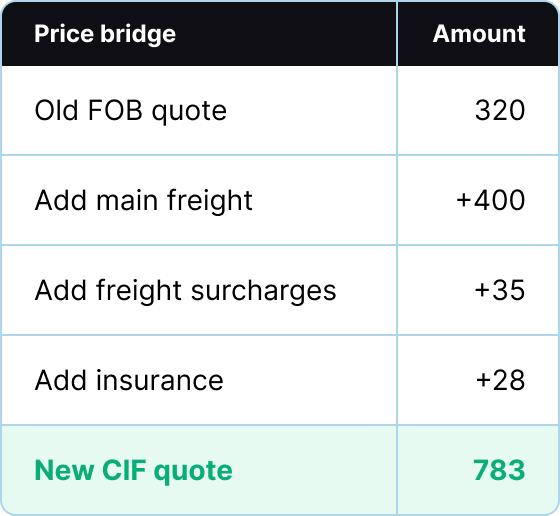
The same logic scales cleanly. CIF→DAP adds destination THC, destination handling, and final delivery where required. DAP→DDP adds import clearance, duty, and tax. EXW→FOB usually deducts buyer-side origin pickup and any EXW-only pre-carriage that sits before the FOB handover point, while keeping export-side vessel-loading scope in seller responsibility.
For freight teams, the safest discipline is to attach every amount to a named component. That protects margin, explains the quote to the customer, and makes transshipment charges visible instead of buried inside a lump sum.
DDP Quoting Checklist: Data Freight Forwarders Must Validate
DDP is where weak data becomes expensive. Before a team finalizes DDP, it should pause and confirm the data that actually drives customs liability.
DDP data requirement | Why it matters |
|---|---|
HS code | Drives classification and duty logic |
Clear goods description | Supports classification and compliance |
Cargo value and currency | Needed for customs value and tax base |
Country of origin | Affects duty treatment and trade preference eligibility |
Destination country | Determines tariff and tax regime |
Importer of record details | Needed for customs execution in many jurisdictions |
Freight and insurance values | Often part of customs value build-up |
Licenses or product controls | Needed for restricted goods |
Quote validity date | Duty, tax, and rate conditions can change |
This is also where named place matters again. "DDP Dubai" is too loose. "DDP Dubai Warehouse, Incoterms 2020" is usable. If the destination site requires unloading equipment, appointment fees, or access restrictions, those should be priced separately. DPU also deserves special care for the same reason, ITA notes that DPU replaced DAT in Incoterms 2020 and adds the seller's unloading obligation at the named destination.
Incoterm Logic in Freight Quoting Workflows: How Wend AI Applies It
Wend AI applies Incoterm logic by treating each rule as a scope engine for the quote, not as a label on the PDF. It maps the selected Incoterm and named place to the exact cost components in play, compares old and new scope when the term changes, looks up each affected line from contract, spot, tariff, or approved historical reference, and then shows a clean price bridge that explains what was added, removed, or left unchanged.
For freight forwarders, the benefit is practical: faster quoting, fewer missed charges, clearer transshipment costing, stronger margin control, and much better customer conversations because every number can be traced back to a responsibility rule and a real rate source.